
Coastal Bend tree work, start to stump
Tree Removal in Corpus Christi, TX
Dead palms, split live oaks, mesquite and storm-damaged trees taken down safely, with the debris hauled off and the stump ground out.
- Free on-site estimates across Corpus Christi and the Coastal Bend
- A clear written price, no lump-sum guessing
- Yard left raked and cleared as agreed
Wind, Salt and Hurricanes Decide Which Trees Stay
Tree removal in Corpus Christi is shaped by the Gulf. The city sits about six and a half feet above sea level on the Coastal Bend, it has one of the windiest climates of any coastal city in North America, and every summer brings the chance of a hurricane. Trees here live with salt spray, long dry spells and steady wind off the bay. Some species handle that remarkably well. Others decline quietly for years and then fail in the first strong storm. Most of the calls we get come down to one of three things: a palm that is dying, a tree that was damaged in a storm, or a tree that has simply grown too close to the house, the pool or the power lines.
Palms and lethal bronzing
Palms are part of almost every Corpus Christi street, and they bring a problem most of the country never sees. Lethal bronzing, a phytoplasma disease spread by a small sap-feeding insect called the American palm cixiid, has been killing palms in the area since many Corpus Christi palms began declining in 2001. The Texas Department of Agriculture lists it in Nueces County along with Cameron, Hidalgo, Willacy and parts of Kleberg County. Canary Island date palms are hit most often in Texas, and queen palms and cabbage palmettos are affected too. The telltale sign on a date palm is the central spear leaf dying, and an infected palm usually dies within about a year. TDA's guidance is that palms that test positive should be removed and destroyed, and confirmed cases reported to the department. That makes dead and dying palm removal a large share of the work on this coast.
Hurricanes and wind
The city's tree history is a storm history. Hurricane Celia came ashore in August 1970 as a Category 4 storm, and the Corpus Christi Weather Bureau office recorded gusts of 161 mph. About a third of the city's houses were badly damaged or destroyed. In 2017 Hurricane Harvey made landfall as a Category 4 just up the coast near Rockport, with an extreme wind warning that covered Nueces and San Patricio counties. Hurricane Hanna affected the city again in 2020. After storms like these, the trees that cause the most trouble are not always the biggest. They are the ones with a weak fork, old decay at the base, a heavy limb reaching over the roof or a top full of dead palm fronds.
Live oaks, mesquite and the trees that hold on
Southern live oak is native along the Texas coast and is extremely resistant to strong sustained winds, thanks to a deep taproot, a wide root system and a low center of gravity. A healthy live oak usually rides out a storm better than the house it shades. We are much more likely to recommend careful pruning for a live oak than removal. Mesquite is a different story: it has paired thorns, deep taproots and buds below ground, so a mesquite that is only cut down tends to come back as a cluster of new trunks. Removing one for good means dealing with the stump as well as the tree.
Ground, water and drought
There is no solid rock at the surface under Corpus Christi. The city sits on river-deposited sand, silt and clay, with layers locally cemented into caliche. Combined with long dry periods and the city's ongoing water supply worries, that means many trees are stressed before a storm ever reaches them. Drought-weakened trees drop limbs, attract borers and lose roots, and those are often the trees that end up on a quote.
Lot by lot
The city has a mix of older neighborhoods near downtown and Ocean Drive, large suburban subdivisions on the Southside, and island and bayfront homes on Padre Island and in Flour Bluff where salt and wind are constant. Owner-occupied homes make up about 58 percent of the city's housing, according to the Census Bureau, and many of those yards have one or two big trees planted when the house was new. Access to the backyard, a pool, a fence and the power line easement usually decide how a tree comes down more than its height does.
Tree Removal and Related Work
Six services cover nearly every tree job on Corpus Christi homes, from one dead palm to a storm-split live oak over the roof.
Palm Tree Removal
Dead, diseased and overgrown palms taken down and hauled off, including date palms lost to lethal bronzing.
Learn more →Storm & Emergency Tree Removal
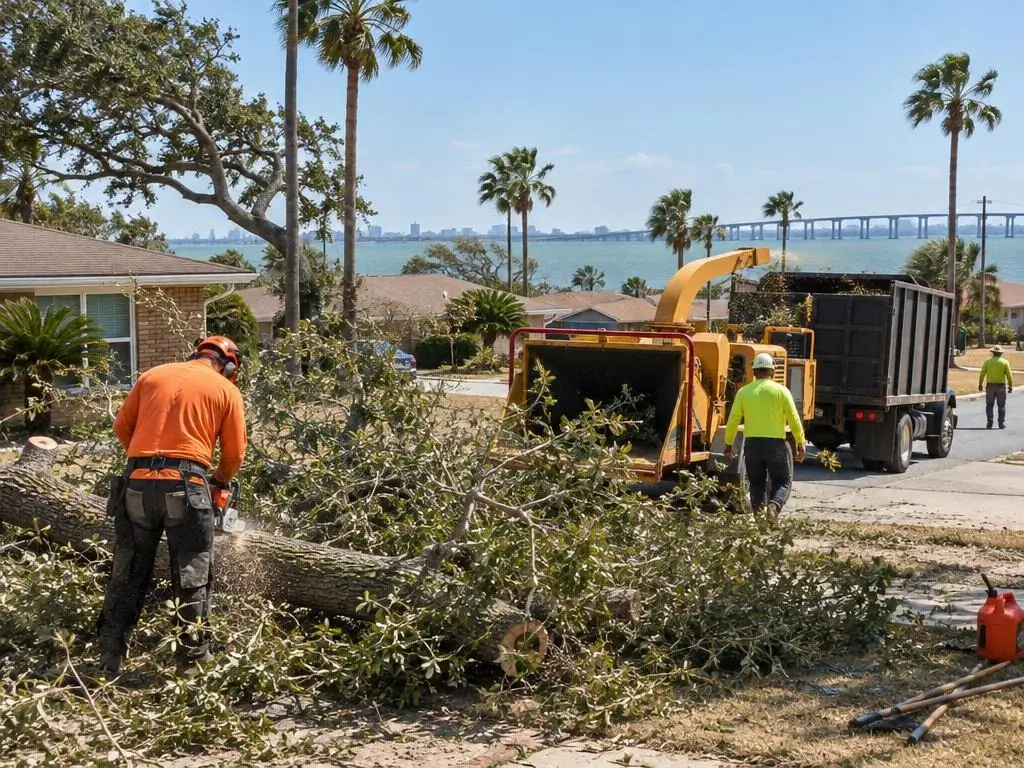
Trees and limbs brought down by hurricanes, squall lines and Gulf wind cleared off roofs, cars, fences and driveways.
Learn more →Dead & Hazard Tree Removal
Dead, dying, cracked and leaning trees taken down on your schedule, before a storm does it for you.
Learn more →Crane-Assisted Tree Removal
Large trees over houses, pools and fences lifted out in sections when climbing and roping would put the property at risk.
Learn more →Tree Trimming & Pruning
Live oak pruning, palm trimming and hurricane-season thinning that keeps good trees and reduces storm damage.
Learn more →Stump Grinding & Removal
Stumps ground below grade so you can mow, plant or pave, including mesquite stumps that keep resprouting.
Learn more →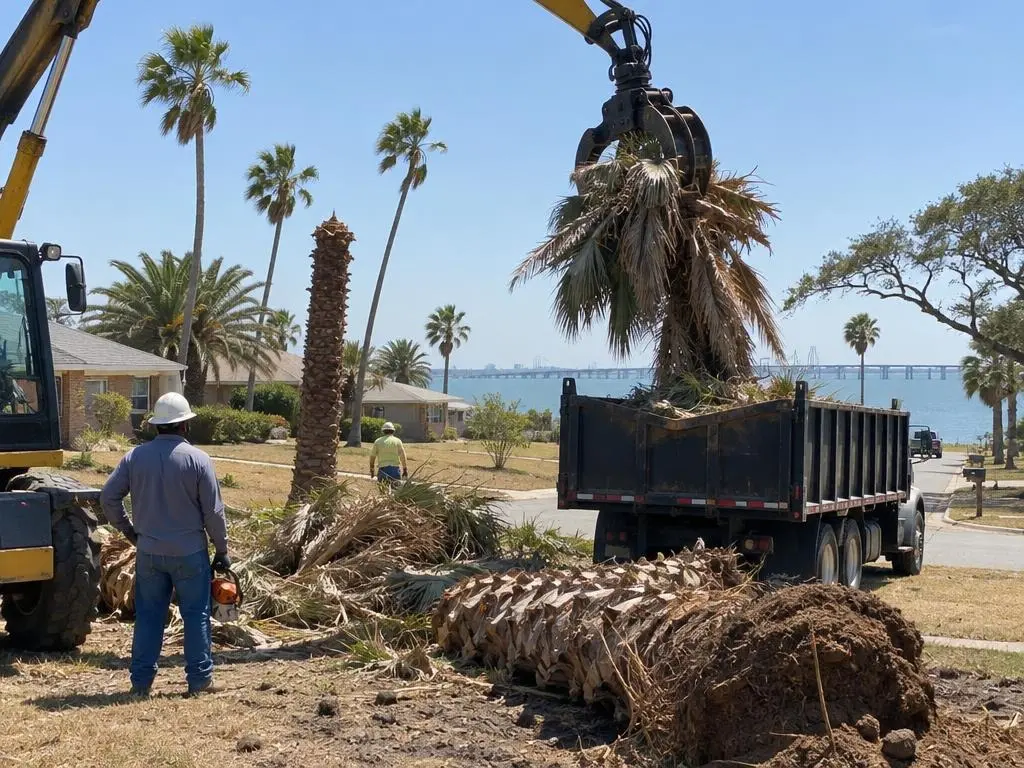
Neighborhoods and Towns We Reach
Corpus Christi is the center of our area, including the Southside, Flour Bluff, Calallen, the neighborhoods off Ocean Drive and the homes on North Padre Island. From there we work around the bays: Portland, Gregory and the San Patricio County towns to the north across the bridge; Ingleside, Aransas Pass and Port Aransas toward the barrier islands; Robstown and the farm towns to the west; and south toward Kingsville. The whole area shares the same hurricane exposure, salt air and palm disease. What changes is the ground and the setting: sandy island lots, older shaded streets in town, and open country lots where mesquite and brush take over. Each area page covers what we found about that place.
- Tree Removal in Corpus Christi, TX
- Tree Removal in Flour Bluff, TX
- Tree Removal in Calallen, TX
- Tree Removal in North Padre Island, TX
- Tree Removal in Portland, TX
- Tree Removal in Gregory, TX
- Tree Removal in Ingleside, TX
- Tree Removal in Aransas Pass, TX
- Tree Removal in Port Aransas, TX
- Tree Removal in Rockport, TX
- Tree Removal in Fulton, TX
- Tree Removal in Taft, TX
- Tree Removal in Sinton, TX
- Tree Removal in Odem, TX
- Tree Removal in Robstown, TX
- Tree Removal in Banquete, TX
- Tree Removal in Agua Dulce, TX
- Tree Removal in Driscoll, TX
- Tree Removal in Bishop, TX
- Tree Removal in Kingsville, TX
Why Homeowners Call Tree Removal Corpus Christi
Palm problems recognized
We look for the dead spear leaf and fruit drop that point to lethal bronzing and explain why a dying palm near others should come out soon.
Storm-ready advice, not just cutting
Before hurricane season we tell you which trees are likely to fail and which only need dead wood and heavy limbs taken off.
Utility lines handled the right way
If a tree touches an AEP Texas line, we tell you so and point you to the utility before any work near that wire.
Every line item in writing
Your quote names each tree, the method, the stump, the cleanup and the price. Changes are agreed with you first.
Common Questions
How much does tree removal cost in Corpus Christi?
This Old House puts the average Corpus Christi tree removal at about $572, with most jobs between roughly $279 and $1,226, and Angi's 2026 figures for Texas run about $300 to $850. Big trees over houses, pools or lines cost more, and Angi adds 25 to 50 percent for tight or unsafe access. We give a written price after seeing the tree.
My palm's center leaf turned brown. Does it need to come out?
A dead central spear leaf on a date palm is the most distinctive sign of lethal bronzing, which is present in Nueces County. The Texas Department of Agriculture advises removing and destroying palms that test positive, because the disease is spread by insects to nearby palms and infected trees usually die within a year. Your county extension office can help with testing; we can remove the palm and haul it away.
Do I need a permit to remove a tree on my own property in Corpus Christi?
Texas has no state license or permit for cutting a tree on private property. A tree in the public right-of-way, one required by a development plan, or a property with HOA or deed rules can be different, so check with the city or your HOA if any of those apply. We tell you at the estimate if a tree looks like it stands on public land.
Can I cut my neighbor's branches that hang over my yard?
Under Texas law you can generally trim branches that cross onto your property, up to the property line and from your own side, as long as you do not kill or seriously damage the tree. Talking to the neighbor first avoids most disputes. If the whole tree is the problem, it is the owner's decision to remove it.
Who removes a tree that is touching a power line?
Not a regular tree company. Call AEP Texas, which runs its own vegetation program, at 1-866-223-8508 or use its online tree problem report. Once the line is made safe or the power is cut, we can take down the rest of the tree.
Should I take trees down before hurricane season?
Not every big tree. Healthy live oaks are among the most wind-resistant trees on the coast. The ones to deal with before June are dead or dying trees, palms with heavy dead skirts, trees with cracks or decay at the base, and limbs hanging over the roof. A short walk-around in spring is cheaper than storm cleanup in September.
Will the city pick up the brush if I cut a tree myself?
The city collects heavy brush, meaning limbs over three inches thick, only during scheduled set-out periods. Piles can be no larger than 6 feet high, 10 feet long and 6 feet deep, placed near the curb but not in the street, gutter or ditch, and extra truckloads are charged. When we remove a tree, hauling the debris is part of the quote.
Is there a tree removal company near me on Padre Island or in Flour Bluff?
Yes. We work on the island and in Flour Bluff as part of our regular area. Those lots are sandy and exposed to salt wind, so palms and wind-damaged trees are most of the work there.
Request Your Free Tree Removal Quote
Free on-site estimates in Corpus Christi and around the bay, with a written quote before any cutting.